BYD has spent the last two years proving that affordable EVs do not have to feel cheap. Now the company is pushing that idea even further by bringing LiDAR-equipped driver assistance technology to one of the least expensive electric cars on the market.
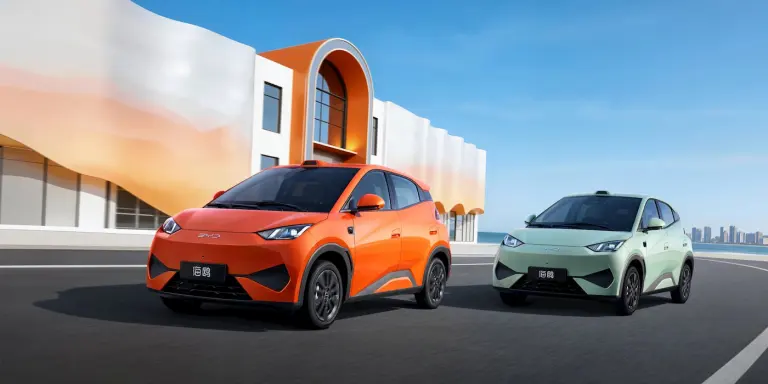
The updated 2026 BYD Seagull starts at just 69,900 yuan (about $10,300), yet some versions now offer BYD’s “God’s Eye B” smart driving system complete with a roof-mounted LiDAR sensor. That makes the Seagull the first A00-class EV — essentially China’s smallest mainstream city-car category — to offer this kind of hardware.
In practical terms, BYD is putting technology once reserved for premium EVs into a car priced closer to an entry-level gasoline hatchback.
That matters more than the specifications alone suggest.
The Seagull was already a massive success before this update. Sold as the Dolphin Surf in Europe and Dolphin Mini in several overseas markets, the compact EV became BYD’s best-selling pure electric vehicle in 2025, delivering nearly 450,000 units globally. It also ranked among the world’s top five best-selling EVs overall.
The formula was simple: small size, low operating costs, and enough range for everyday urban driving.
Now BYD is adding software and automation into the mix.
The 2026 Seagull comes in six variants with two battery options. Entry-level versions use a 30.08 kWh battery pack delivering up to 305 km of CLTC range, while higher trims receive a larger 38.88 kWh pack good for up to 405 km.
Those numbers sound impressive, although CLTC estimates tend to be more optimistic than EPA ratings used in the US. Realistically, buyers should expect lower everyday driving range, especially at highway speeds. Still, for urban commuters or short-distance drivers, the Seagull’s battery options are more than adequate.
And that’s exactly the point.
The Seagull is not trying to compete with long-range premium EVs like the Tesla Model 3 or Tesla Model Y. It’s targeting a completely different audience: first-time EV buyers, younger city drivers, and consumers upgrading from gasoline microcars.
Physically, the Seagull is tiny. At 3,780 mm long, it’s roughly comparable to a Kia Picanto and even smaller than the upcoming Chevrolet Bolt EV redesign expected in North America.
That compact footprint gives it major advantages in crowded cities where parking space and maneuverability matter more than outright performance.
The biggest story, however, is the LiDAR system.
BYD’s optional God’s Eye B package adds roof-mounted LiDAR alongside advanced driver assistance features like highway and city Navigation on Autopilot (NOA). In simple terms, LiDAR uses lasers to create a detailed 3D map of the environment around the car, helping the system better detect vehicles, pedestrians, and road layouts.
Most automakers reserve LiDAR for expensive premium models because the hardware adds significant cost. BYD is doing the opposite: aggressively pushing it downmarket.
That strategy could reshape consumer expectations for affordable EVs.
Until recently, buyers choosing budget electric cars typically had to sacrifice advanced software features, driver assistance, or premium interiors. The Seagull increasingly blurs those lines. Even the cabin now feels more sophisticated than its price suggests, thanks to a new 12.8-inch floating infotainment display and BYD’s upgraded DiLink 150 smart cockpit system.
Still, there are tradeoffs.
The Seagull’s single 55 kW motor produces just 73 horsepower, meaning performance will likely feel modest outside city environments. This is not a fast EV, nor is it designed to be one. Highway overtaking and sustained high-speed driving may feel strained compared to larger EVs.
There is also a broader question surrounding driver assistance technology in ultra-cheap vehicles. While adding LiDAR sounds impressive, advanced driving systems are only as good as their software calibration and real-world reliability. Buyers should not confuse affordable automation with true autonomous driving.
But even with those caveats, the Seagull represents something bigger happening in China’s EV market.
Chinese automakers are rapidly turning once-premium technologies into mass-market features. Large touchscreens, over-the-air software updates, AI-powered cabins, and now LiDAR-assisted driving are all moving into cars that cost barely more than economy gasoline vehicles.
That trend is becoming increasingly difficult for Western automakers to ignore.
The 2026 BYD Seagull may not be exciting in the traditional enthusiast sense. It is small, inexpensive, and designed primarily for dense urban environments. But strategically, it could become one of the most important EVs of the year because it shows how quickly advanced EV technology is becoming commoditized.
And if BYD can profitably sell a LiDAR-equipped EV for under $15,000, the pressure on the global auto industry is only going to intensify.