Hyundai appears ready to move far beyond the lifestyle-focused Hyundai Santa Cruz and into serious truck territory. A newly revealed patent, combined with the rugged Boulder Concept shown earlier this year, offers the clearest look yet at Hyundai’s upcoming body-on-frame electric platform—and the company’s ambitions are much bigger than building another crossover with a bed.
This is Hyundai preparing for the part of the market dominated by vehicles like the Toyota Tacoma, Ford Ranger, Ford Bronco, and Jeep Wrangler.
And unlike many current EVs, this one appears designed from the start for real off-road use.
The key detail is the platform itself.
Most electric SUVs today use unibody construction, where the body and chassis are integrated into a single structure. That setup is lighter, more efficient, and generally better for on-road driving. But serious trucks and off-road vehicles often use body-on-frame construction, where the vehicle body sits on top of a separate ladder-style frame.
That design is heavier, but it’s stronger, easier to repair, and better suited for towing, rock crawling, and rough terrain.
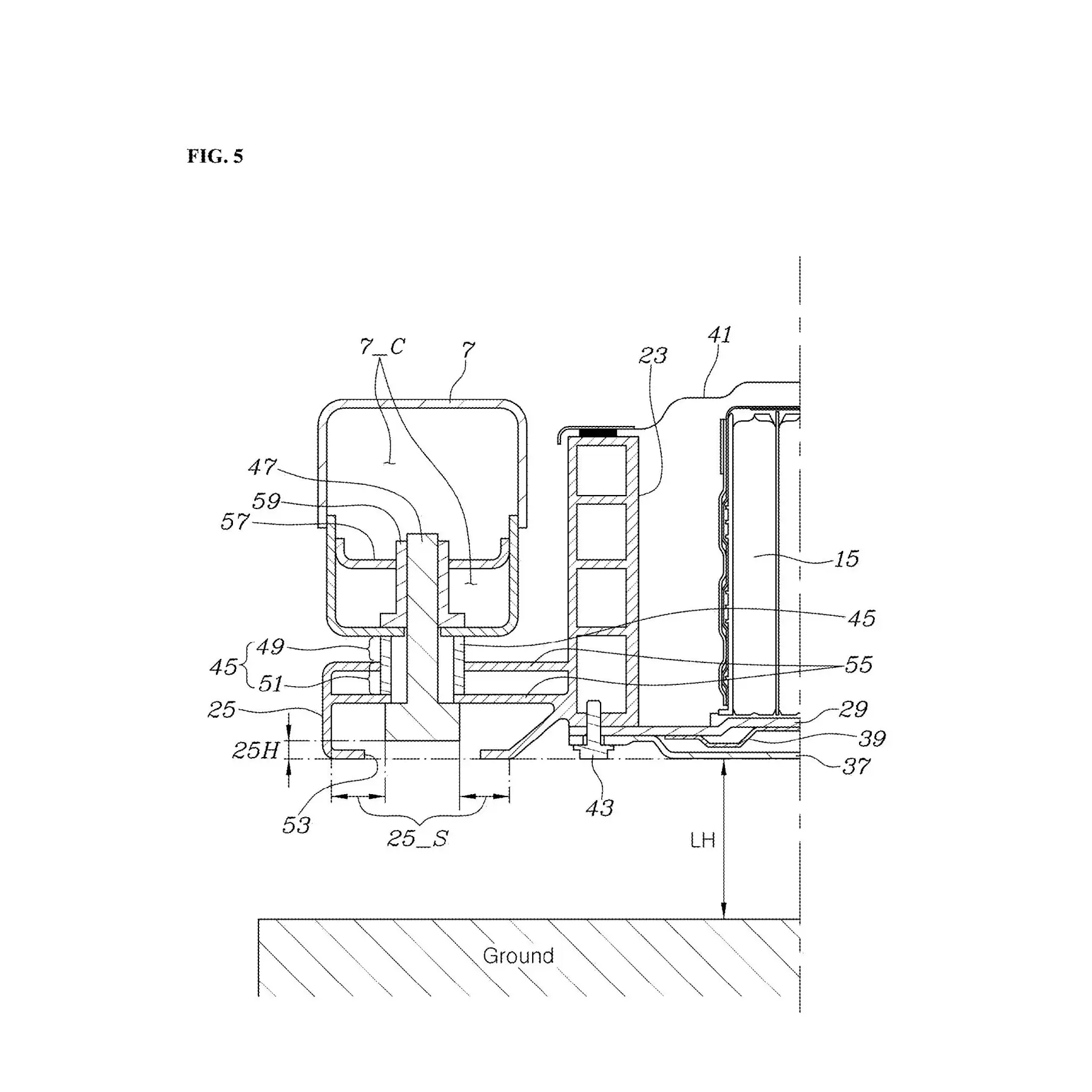
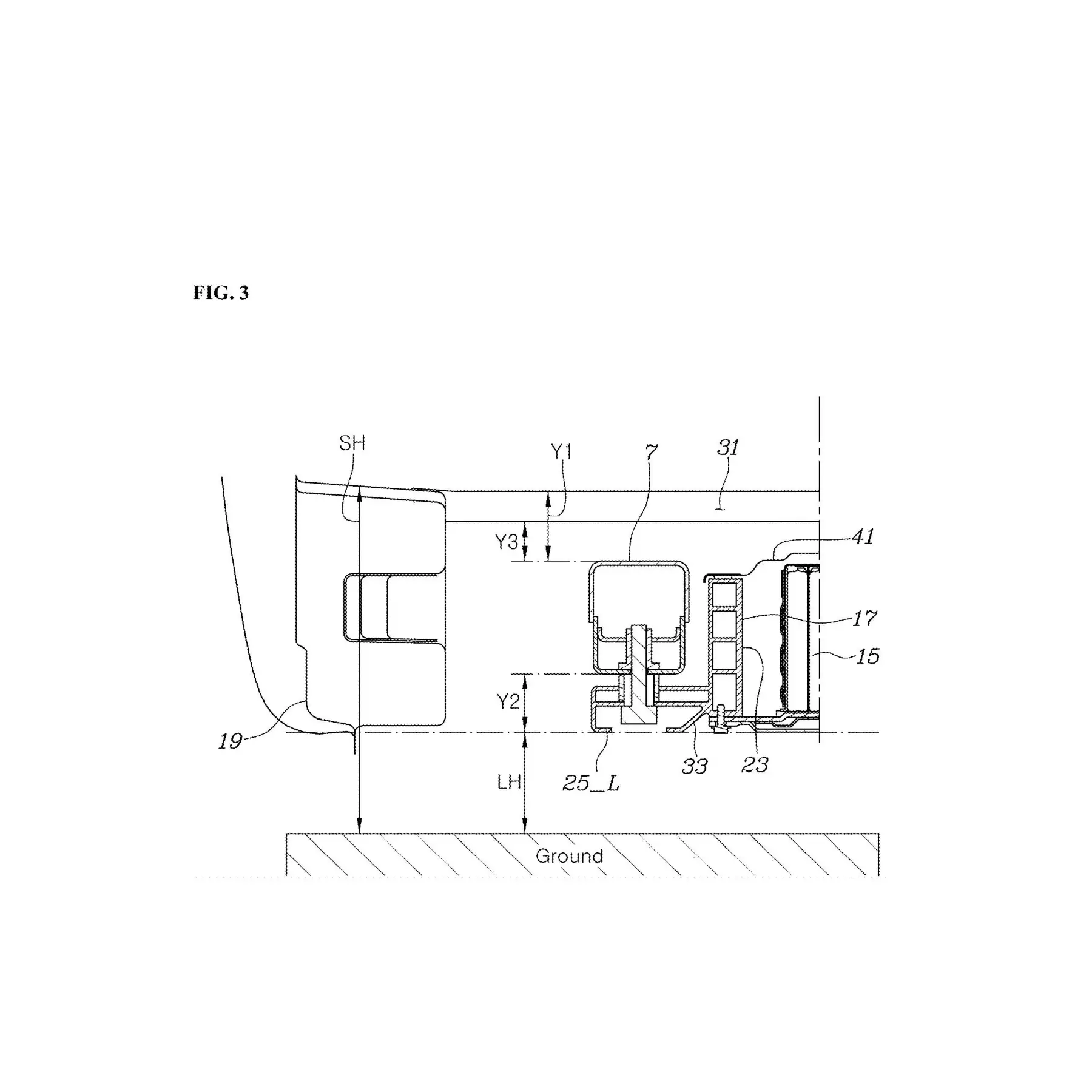
Hyundai’s new patent focuses specifically on how an EV battery can work within that traditional truck architecture. The filing describes a battery pack integrated between frame rails in a way that protects the pack while maintaining ground clearance and lowering the vehicle’s center of gravity.
In simple terms, Hyundai is trying to solve one of the biggest challenges of electric off-road vehicles: how to carry a large battery without compromising durability or capability.


That’s harder than it sounds.
Batteries are heavy and vulnerable to impacts, especially in off-road conditions where rocks, water crossings, and suspension articulation become serious engineering concerns. Traditional EV skateboard platforms work well for road cars, but body-on-frame trucks require a different balance between protection, rigidity, and suspension travel.
Hyundai’s solution appears aimed at preserving both interior space and off-road performance.
The Boulder Concept offered a strong preview of where this is heading aesthetically. With oversized 37-inch mud-terrain tires, tow hooks, roof racks, and safari-style upper windows, the SUV looked far more aggressive than anything currently in Hyundai showrooms.
And notably, it didn’t look like a typical futuristic EV concept.
Instead, Hyundai seems to be leaning into traditional off-road design language—boxy proportions, high clearance, visible utility features—rather than trying to reinvent what a rugged SUV should look like.
That’s probably the right move.
The off-road market is deeply conservative compared to the broader EV industry. Buyers care less about minimalist interiors or experimental styling and more about reliability, capability, towing, and aftermarket potential. Rivals like the Rivian R1T proved there’s demand for electric adventure vehicles, but Hyundai appears to be targeting a more mainstream and potentially lower-cost segment.
The company is also keeping its options open mechanically.
Reports suggest the platform may support not only battery-electric versions, but also hybrids, internal combustion engines, and extended-range EV setups. That flexibility could help Hyundai adapt more quickly as truck buyers transition toward electrification at different speeds.
There are clear advantages to this strategy.
A shared platform lowers development costs, broadens market reach, and reduces the risk of committing too aggressively to one powertrain. It also allows Hyundai to compete across multiple segments without building entirely separate vehicles.
But there are trade-offs too.
Body-on-frame vehicles are heavier and generally less efficient than unibody EVs, which can hurt driving range. Off-road tires, higher ride heights, and towing capability further reduce efficiency—something every electric truck manufacturer is still struggling to optimize.
Charging infrastructure also remains a challenge for remote outdoor use.
That’s where Hyundai’s broader ecosystem matters. If the truck eventually adopts the company’s 800-volt EV architecture and gains access to Tesla’s North American Charging Standard (NACS), it could become far more practical for long-distance adventure travel than many current competitors.
Still, Hyundai has time before launch.
The truck is reportedly part of the company’s plan to introduce 36 new vehicles in North America by 2030, with production expected in the U.S. using domestically sourced steel. That local manufacturing push could become especially important as tariffs and EV sourcing regulations continue reshaping the market.
Conclusion:
Hyundai’s upcoming body-on-frame EV platform could become one of the company’s most important vehicles of the decade. Rather than simply electrifying another crossover, Hyundai appears focused on solving the harder problem: building an electric truck and SUV platform that traditional off-road buyers might actually respect. If it can combine real capability with competitive pricing and modern EV technology, Hyundai may finally have a legitimate challenger to the Tacoma, Bronco, and Wrangler—not just another lifestyle EV.