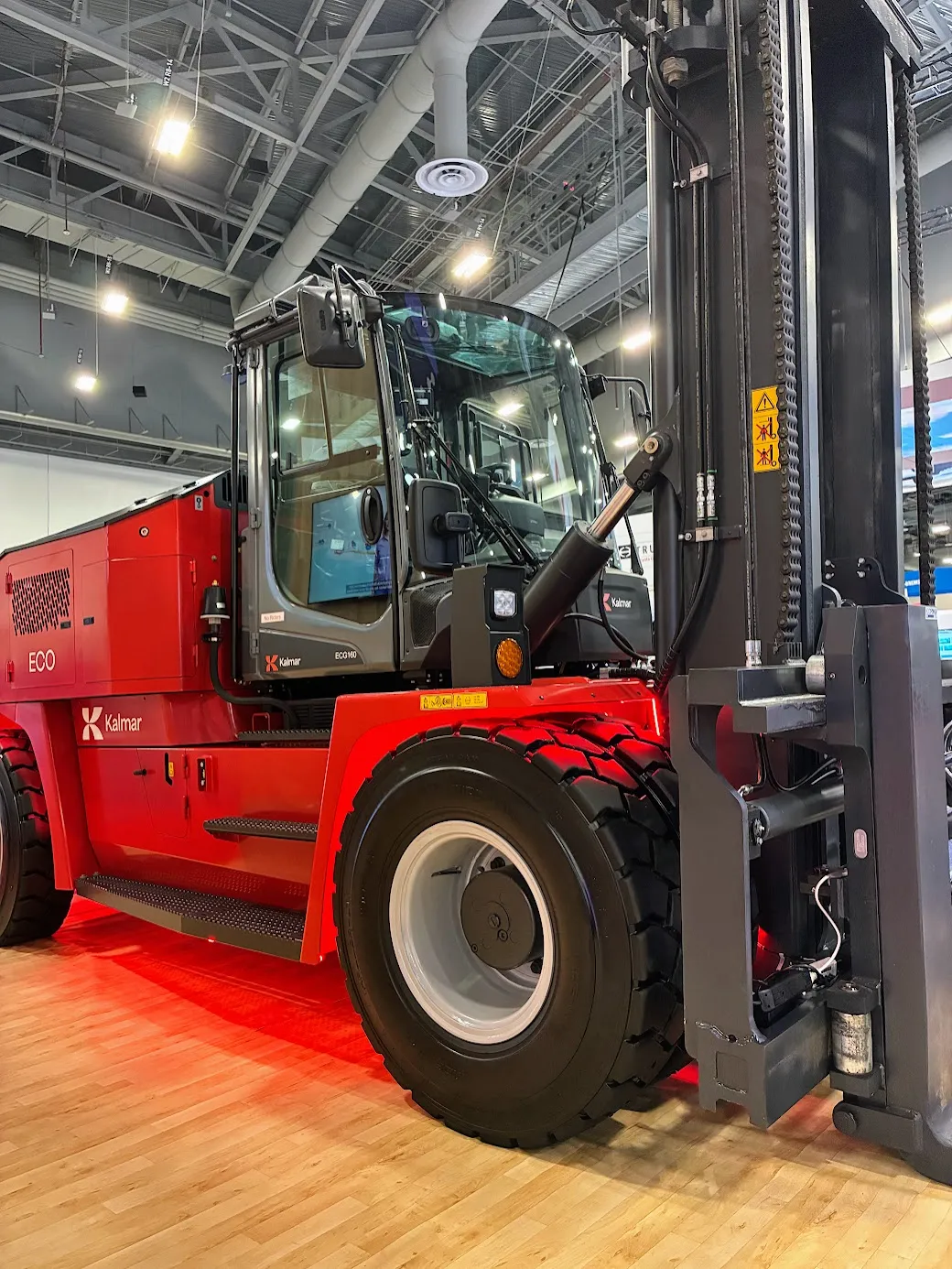
Kalmar unveiled its first lithium-ion-powered electric “medium” forklift at ACT Expo this week, but the company’s definition of “medium” is a little different from most people’s. This machine can lift up to 40,000 pounds.
And in Kalmar’s world, that still sits well below its largest heavy-duty models.
The new electric forklift represents a significant step in the electrification of industrial equipment, particularly in sectors where diesel and lead-acid-powered machines have long dominated due to sheer workload demands. Industries like forestry, steel, shipping, and heavy logistics typically prioritize uptime and brute force over sustainability claims, making them some of the hardest sectors to electrify.
That’s exactly why this launch matters.
Kalmar’s new forklift replaces traditional lead-acid battery systems with lithium-ion technology, bringing several practical improvements that directly affect operations. The biggest is charging time. The new system can recharge in roughly two hours and supports opportunity charging between shifts, allowing operators to top off the battery during breaks instead of waiting for full overnight charging cycles.
In real-world warehouse and industrial environments, that can dramatically reduce downtime.
Traditional lead-acid forklifts often require battery swapping infrastructure, dedicated charging rooms, and long cooling periods. Lithium-ion systems simplify much of that process while also reducing maintenance needs. There’s no watering, fewer moving components, and more consistent power delivery across the battery’s charge cycle.
That consistency becomes especially important in heavy-duty applications.
Unlike smaller warehouse forklifts, Kalmar’s machines are built to move lumber, steel coils, containers, and bulk industrial materials. Power fluctuations or performance drops under load can directly affect productivity and safety. Kalmar says its new Thermal Management System helps maintain stable battery temperatures across demanding operating conditions, which is critical for preserving battery lifespan and maintaining consistent lifting performance.
In simpler terms, the company is trying to solve one of the biggest weaknesses of industrial electrification: reliability under continuous heavy use.
The forklift itself remains highly configurable, with support for different mast heights, fork designs, carriages, and specialized attachments depending on the industry. That flexibility matters because industrial operators rarely buy standardized equipment. A steel plant, lumber yard, and port facility all have very different handling requirements.
Electrification only works if the machines still fit into existing workflows.
There are also meaningful benefits for operators. Electric forklifts are significantly quieter than diesel-powered equipment and produce less vibration, improving comfort during long shifts. That may sound secondary compared to lifting capacity or battery specs, but operator fatigue and cabin ergonomics directly affect productivity and workplace safety in industrial settings.
The tradeoffs, however, are still real.
Lithium-ion systems remain more expensive upfront than traditional lead-acid solutions, and large industrial batteries can become costly to replace over time. Charging infrastructure upgrades may also be necessary for facilities transitioning from combustion-powered equipment to electric fleets.
And while electric forklifts work well indoors and in controlled industrial environments, extremely remote or continuous 24/7 operations may still favor diesel in certain cases, at least for now.
Even so, the economics are shifting quickly.
As battery prices continue falling and emissions regulations tighten globally, electrification is becoming less about sustainability branding and more about operational efficiency. Lower maintenance, reduced fuel costs, and simpler fleet management increasingly offset higher purchase prices over the lifespan of industrial equipment.
That’s why companies like Kalmar are expanding beyond small warehouse vehicles into much larger heavy-duty categories.
The broader trend mirrors what’s happening across commercial transportation. Electrification started with passenger cars, moved into delivery vans and buses, and is now steadily entering industries once considered too demanding for battery power.
Heavy equipment is no longer exempt from that transition.
Conclusion:
Kalmar’s new lithium-ion electric forklift is more than just another industrial EV announcement. It highlights how battery technology is becoming capable enough for genuinely heavy-duty work, even in sectors traditionally dominated by diesel and lead-acid equipment. The transition won’t happen overnight, and challenges around cost and infrastructure remain, but the direction is increasingly clear: industrial electrification is moving from experimental to practical.