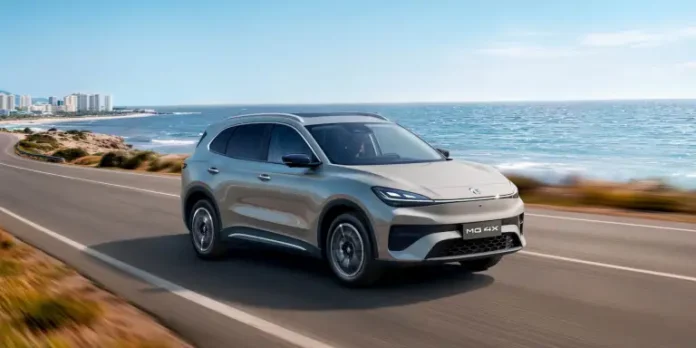
Lexus has officially entered one of the fastest-growing segments in the EV market with the new 2027 TZ, its first fully electric three-row SUV. Positioned as the premium sibling to the upcoming Toyota Highlander BEV, the TZ is aimed directly at rivals like the Hyundai IONIQ 9, Volvo EX90, and Rivian R1S.
And at first glance, Lexus appears to have delivered most of what buyers expect from a modern luxury EV.
The TZ rides on Toyota’s TNGA-based EV platform and will launch with two battery options, offering up to 300 miles of range. That figure is competitive, though not class-leading, especially as rivals continue pushing beyond the 300-mile threshold in real-world driving conditions.
Performance is solid but clearly tuned more for comfort than outright speed.
Every TZ comes standard with Lexus’ DIRECT4 all-wheel-drive system, which continuously adjusts torque distribution between the front and rear wheels. In simple terms, the SUV is designed to feel more stable and controlled during acceleration and cornering, particularly in poor weather or on uneven roads.
The system produces up to 420 horsepower and allows towing up to 3,500 pounds.
That’s respectable for a family-focused luxury EV, but competitors like the Hyundai IONIQ 9 and Rivian R1S offer significantly higher towing capacities, giving them an edge for buyers planning to haul boats, trailers, or camping gear regularly.

Where Lexus leans hardest is refinement.
The company says the TZ has the quietest cabin of any Lexus SUV so far, thanks to additional sound insulation, revised suspension tuning, and structural changes designed to reduce vibration. Combined with reclining second-row captain’s chairs, ventilated seating, ottomans, and a 21-speaker Mark Levinson audio system, the overall focus is clearly on comfort over sportiness.
In many ways, the TZ feels closer to an electric luxury lounge than a tech-first SUV.
That approach helps differentiate it from rivals like the Rivian R1S, which emphasizes adventure and utility, or the Hyundai IONIQ 9, which leans more heavily into futuristic design and value-focused technology.
Lexus is also modernizing its software experience.
The updated Lexus Interface system adds customizable widgets, improved voice controls, EV route planning, and charging-aware navigation. The SUV also adopts Tesla’s North American Charging Standard (NACS), giving drivers access to the extensive Tesla Supercharger network—a feature quickly becoming essential in the U.S. EV market.

Charging speeds, however, are less impressive.
The TZ tops out at 150 kW DC fast charging, allowing a 10% to 80% recharge in roughly 35 minutes. That’s usable, but slower than newer 800-volt competitors from Hyundai, Kia, and Lucid, many of which can recover comparable range much faster under ideal conditions.
And then there’s the missing frunk.
For an EV launching in 2027, the lack of a front trunk feels oddly conservative. Many buyers now expect EV-specific packaging advantages, especially in larger SUVs where extra storage can make a meaningful difference for families. Lexus reportedly may offer one later, but its absence at launch reinforces the sense that the TZ prioritizes familiarity over reinvention.
That philosophy runs through the entire vehicle.
The TZ doesn’t appear designed to radically redefine luxury EVs. Instead, Lexus seems focused on making the transition to electric feel comfortable and low-risk for traditional buyers who already trust the brand.

There’s value in that approach.
Not every luxury EV customer wants experimental interfaces, extreme acceleration, or spaceship aesthetics. Some simply want a quiet, premium SUV with strong reliability, practical range, and access to modern charging infrastructure.
The challenge is that the market is evolving quickly.
By the time the TZ launches in late 2026, competitors will likely push even further in charging speed, software sophistication, and interior flexibility. Lexus may win buyers seeking comfort and familiarity, but it risks looking conservative in a segment increasingly defined by innovation.
Conclusion:
The 2027 Lexus TZ looks like a well-executed luxury EV SUV with strong comfort, premium refinement, and practical everyday usability. But it also feels cautious at a time when competitors are taking bigger risks. Lexus may succeed by appealing to traditional luxury buyers—but in the rapidly evolving EV market, playing it safe is becoming its own gamble.