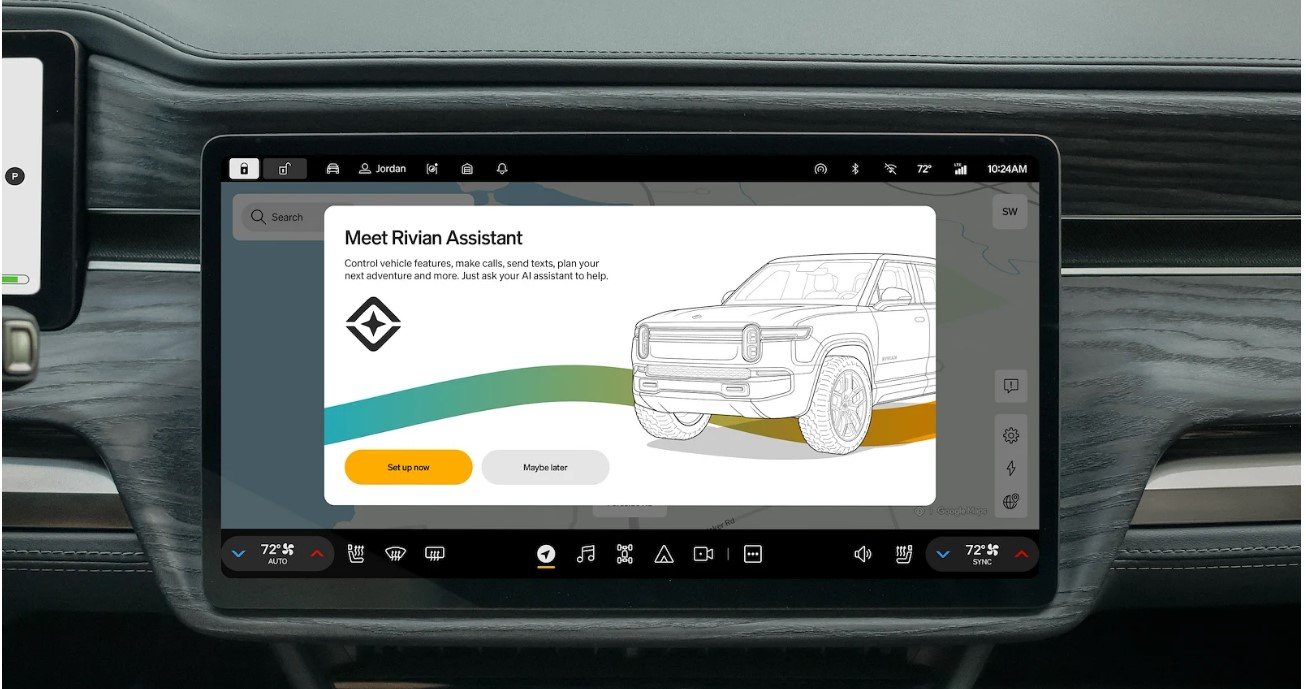
Rivian is rolling out a new AI-powered voice assistant to owners of its R1T and R1S vehicles, and unlike many in-car assistants before it, this one can actually control the vehicle in meaningful ways.
The new feature arrives through Rivian’s latest over-the-air software update and is available to both Gen 1 and Gen 2 R1 owners with an active Connect+ subscription. Drivers can activate it by saying “Hey Rivian” or by holding the left steering wheel button.
On the surface, that may sound similar to other automotive voice assistants already on the market. In practice, Rivian’s implementation is more ambitious — and more deeply integrated into the vehicle itself.
The assistant is powered by what Rivian calls “Rivian Unified Intelligence,” a software framework that combines large language models with direct access to the car’s internal systems. Instead of behaving like a smartphone assistant projected onto a dashboard screen, the system is built directly into the vehicle architecture.
That distinction matters.
Most in-car voice systems, including Siri through Apple CarPlay or Google Assistant through Android Auto, are limited because they operate primarily through the driver’s phone. They can handle messaging, navigation, or music requests, but they generally cannot control core vehicle systems in a meaningful way.
Rivian’s assistant can.
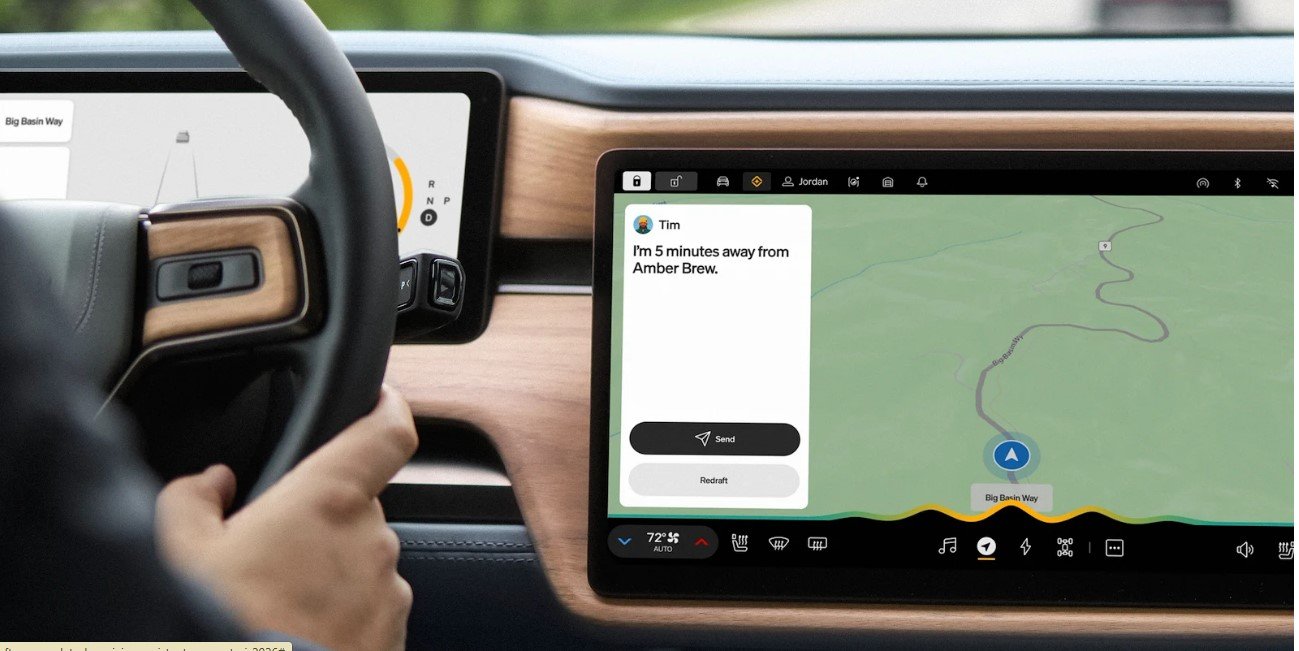
Drivers can adjust climate settings, change drive modes, raise or lower ride height, open the front trunk, check estimated battery range on arrival, and even control seat heating using natural language. Rivian says the assistant can also interpret multi-step or context-aware requests rather than relying entirely on rigid command phrases.
For example, instead of saying separate commands for each action, a driver could ask the system to warm the passenger seat, navigate to a coffee shop on the route to an appointment, and text someone an updated ETA.
That level of integration is where Rivian currently stands apart from several competitors.
The comparison with Tesla is particularly notable. Tesla introduced its own “Hey Grok” assistant earlier this year through a software update powered by xAI’s Grok language model. While Tesla’s system can answer questions, search navigation destinations, and pull information from the owner’s manual, it still lacks direct control over many core vehicle functions.
Months after launch, Tesla’s assistant still cannot reliably adjust climate controls, drive settings, or vehicle hardware through conversational commands.
Rivian’s assistant launches with those capabilities already built in.
That does not necessarily mean Rivian’s AI is more advanced overall, but it does suggest the company has prioritized practical in-car usefulness over generalized chatbot behavior. In an automotive context, that may matter more to drivers than broad conversational intelligence.
The assistant also includes several features designed around daily convenience rather than novelty.
It can summarize incoming text messages, help draft replies in a more natural tone, answer troubleshooting questions based on the owner’s manual, and provide live weather or local information. Rivian says the system uses an “agentic framework,” meaning it can combine multiple actions across apps and vehicle systems into a single request.
The first major third-party integration is Google Calendar.
Drivers can ask the assistant about upcoming meetings, modify schedules, or combine appointments with navigation and messaging workflows. It is a small example of how automakers increasingly want vehicles to function more like connected digital environments rather than isolated transportation devices.
Still, there are limitations.
The feature currently works only in English and requires a cloud connection, meaning reliability may depend on network availability. Rivian also places the assistant behind its Connect+ subscription, which costs $14.99 per month or $149.99 annually.
That subscription model mirrors a growing industry trend.
Automakers increasingly see software services as recurring revenue opportunities rather than one-time product features. Tesla does the same with Premium Connectivity and Full Self-Driving subscriptions. Consumers may eventually accept that model, but there is still tension around paying ongoing fees for functions tied closely to vehicles that already cost tens of thousands of dollars.
Privacy may also remain a concern for some buyers.
Rivian says users can disable the wake word, limit location sharing, and turn off memory features entirely. Personal context learned by the assistant is stored within individual driver profiles rather than shared broadly across users.
The timing of this rollout is also important strategically.
Rivian first previewed its broader AI ambitions during its AI and Autonomy Day in late 2025, where the company revealed custom silicon chips and long-term Level 4 autonomy goals. This assistant becomes the first real-world consumer product emerging from that initiative.
And it gives Rivian something increasingly valuable in the EV market: software differentiation.
Battery range and acceleration are no longer enough to stand out in the premium EV segment. As hardware differences narrow, user experience and software integration are becoming more important competitive advantages. Rivian appears to understand that earlier than many traditional automakers.
The company’s upcoming Rivian R2 is expected to push this even further, using dedicated AI compute hardware designed specifically for these kinds of features.
Whether drivers fully embrace AI assistants inside vehicles remains an open question. Many voice systems still frustrate users more than they help them. But Rivian’s approach feels notably more practical than most because it focuses on reducing friction inside the driving experience rather than simply adding another chatbot to the dashboard.
And right now, that makes Rivian’s assistant one of the clearest examples of how AI can genuinely improve modern vehicles — not just market them.