
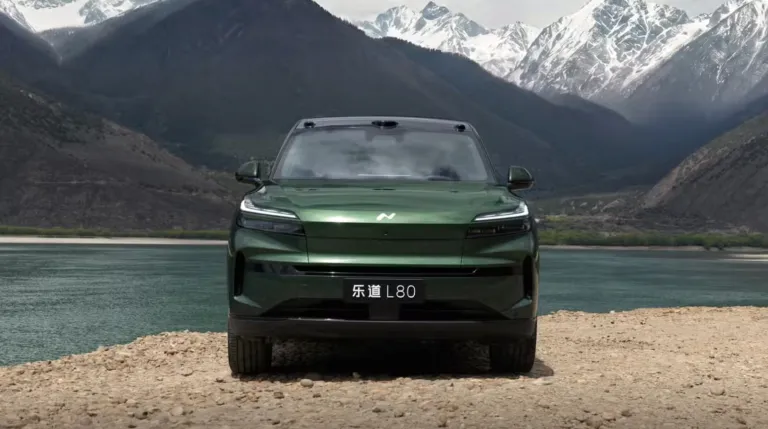
Nio is turning up the pressure in China’s most competitive EV segment. Its budget-focused sub-brand Onvo has officially launched the Onvo L80, a five-seat electric SUV starting at 245,800 yuan (about $36,000)—roughly $2,400 less than the Tesla Model Y in China.
Pre-orders are now open, with deliveries set to begin May 15. That timing matters. The mid-size electric SUV category is the most crowded—and strategically important—segment in the world’s largest EV market.
A Familiar Platform, Repackaged for Value
The L80 isn’t built from scratch. It’s essentially a two-row version of the larger L90, sharing the same NT 3.0 platform, 900-volt electrical system, and core components.
That kind of platform reuse is becoming standard across the industry, but here it’s used to drive cost down while maintaining features typically reserved for higher-end models.
The result is straightforward: a large SUV experience at a lower price.
Size and Space as a Selling Point
At over 5.1 meters long, the L80 is significantly larger than the Tesla Model Y, which sits closer to 4.75 meters. That extra length translates directly into interior space.
With the rear seats folded, Onvo claims up to 2,840 liters of cargo capacity—positioning the L80 as one of the most practical five-seat SUVs in its class.
For buyers, that means more room for luggage, gear, or family use—an area where size still matters more than acceleration figures.
Performance That Keeps Up
The L80 offers two powertrain options:
- Rear-wheel drive with a single 340 kW motor (0–100 km/h in 5.9 seconds)
- All-wheel drive with dual motors producing 440 kW (0–100 km/h in 4.7 seconds)
Those numbers are competitive with the Model Y, especially considering the L80’s larger size.
In real-world terms, both configurations provide more than enough performance for daily driving, highway merging, and overtaking.
Battery, Range, and a Key Differentiator
While official range figures for the L80 haven’t been finalized, it’s expected to match or slightly exceed the L90’s 605 km CLTC range, thanks to similar hardware and potentially lower weight.
More importantly, the L80 supports Nio’s battery-swapping system.
Instead of waiting to charge, drivers can replace the battery at a swap station in under three minutes—effectively turning “charging” into a quick stop similar to refueling.
It’s a unique advantage, though limited to regions where Nio’s infrastructure is available.
Assisted Driving Options for Different Budgets
Onvo is offering two driver-assistance setups:
- A higher-end system with LiDAR, multiple sensors, and Nio’s in-house AI chip
- A lower-cost, camera-based system using Nvidia hardware
Both support the company’s assisted driving features, but the difference comes down to capability and cost.
In simpler terms: buyers can choose between more advanced sensing or a more affordable package.
Price: The Real Headline
At 245,800 yuan, the L80 undercuts the Tesla Model Y by a noticeable margin.
That might not seem huge in absolute terms, but in China’s EV market—where pricing is highly competitive—it can significantly influence buying decisions.
And the L80 doesn’t just compete on price. It offers:
- Larger dimensions
- A 900-volt architecture (for faster charging potential)
- Battery swapping
- Optional LiDAR-based driver assistance
That combination puts pressure on Tesla’s premium positioning.
Pros and Cons
Pros
- Lower starting price than the Model Y
- Larger size and more interior space
- Battery swap capability reduces charging time
- Flexible assisted driving configurations
Cons
- Brand recognition and resale value lag behind Tesla
- Battery swap network is still geographically limited
- Final range figures not yet confirmed
- Charging ecosystem less established than Tesla’s
The Bigger Picture
The L80 reflects a broader trend in China’s EV market: domestic brands are no longer just competing on price—they’re matching or exceeding features while still undercutting global competitors.
Tesla’s Model Y remains a strong seller, but its advantage is narrowing as local players close the gap in technology and infrastructure.
Final Verdict
The Onvo L80 is a well-positioned challenger that combines size, technology, and aggressive pricing in a way that directly targets Tesla’s strongest product in China.
It may not match Tesla’s brand strength or charging network—yet.
But in a market driven by value and rapid innovation, the L80 shows how quickly that balance is shifting.